THE CRYPTOGRAPHY GUIDE
| |
.jpg)
Cryptographic Algorithms
DES This is the 'Data Encryption Standard'. This is a cipher that operates on 64-bit blocks of data, using a 56-bit key. It is a 'private key' system. Further Details on the DES Algorithm RSA RSA is a public-key system designed by Rivest, Shamir, and Adleman. Further Details on the RSA Algorithm HASH A 'hash algorithm' is used for computing a condensed representation of a fixed length message/file. This is sometimes known as a 'message digest', or a 'fingerprint'.. MD5 MD5 is a 128 bit message digest function. It was developed by Ron Rivest. Further Details on the MD5 Algorithm AES This is the Advanced Encryption Standard (using the Rijndael block cipher) approved by NIST. SHA-1 SHA-1 is a hashing algorithm similar in structure to MD5, but producing a digest of 160 bits (20 bytes).Because of the large digest size, it is less likely that two different messages will have the same SHA-1 message digest. For this reason SHA-1 is recommended in preference to MD5. HMAC HMAC is a hashing method that uses a key in conjunction with an algorithm such as MD5 or SHA-1. Thus one can refer to HMAC-MD5 and HMAC-SHA1 | |
Friday, 12 July 2013
Cryptographic Algorithms

Wednesday, 10 July 2013
Windows XP Network configuration
Windows XP Professional
Click Start -> Control Panel -> Network Connections.
Alternately, click Start ->, and right-click My Network Places then select Properties.
- On some installations the interface will be called Local Area Connection and on others it will be called Network Bridge. On our system it is called Network Bridge. Right-click on Network Bridge -> Properties.
- The Network Bridge Configuration, or Local Area Connection, panel is used to set TCP/IP protocol settings. In This connection uses the following items: box, click on Internet Protocol (TCP/IP), then click on Properties.The default setting is DHCP-enabled operation (i.e.“Obtain an IP address automatically”).Many network administrators will want to use DHCP to configure all client TCP/IP protocol stack settings.If it is necessary to provide a fixed IP address, click on “Use the following IP address” and enter the IP Address, the subnet mask, and the default gateway address in the boxes provided.
- Click the Advanced button to proceed with TCP/IP configuration. This opens a panel in which it is possible to create additional IP addresses for this interface. The technical name for the additional addresses is IP aliases, and additionally this panel permits the setting of more default gateways (routers). In most cases where DHCP is used, it will not be necessary to create additional settings.
Fixed settings may be required for DNS and WINS if these settings are not provided automatically via DHCP.
- Click the DNS tab to add DNS server settings. The example system uses manually configured DNS settings. When finished making changes, click the OK to commit the settings.DNS Configuration.
- Click the WINS tab to add manual WINS server entries. This step demonstrates an example system that uses manually configured WINS settings. When finished making changes, click OK to commit the settings.WINS Configuration


Network configuration in Linux

How to configure the network card in Red hat enterprise Linux 5 and Centos 5
You can configure network card by editing text files stored in
/etc/sysconfig/network-scripts/ directory.
First change directory to /etc/sysconfig/network-scripts/:
# cd /etc/sysconfig/network-scripts/
You need to edit files as follows:
/etc/sysconfig/network-scripts/ifcfg-eth0 : First Ethernet card configuration file
/etc/sysconfig/network-scripts/ifcfg-eth1 : Second Ethernet card configuration file
To edit/create first NIC file, type command:
# vi ifcfg-eth0
modify as follows:
# Intel Corporation 82573E Gigabit Ethernet Controller (Copper)
DEVICE=eth0
BOOTPROTO=static
DHCPCLASS=
HWADDR=00:30:48:56:A6:2E
IPADDR=192.168.1.2
NETMASK=255.255.255.0
ONBOOT=yes
Save and close the file. Define default gateway (router IP) and hostname in
/etc/sysconfig/network file:
# vi /etc/sysconfig/network
Append/modify configuration as follows:
NETWORKING=yes
HOSTNAME=server1.example.com
GATEWAY=192.168.1.1
Save and close the file. Restart networking:
# /etc/init.d/network restart
Make sure you have correct DNS server defined in /etc/resolv.conf file:
# vi /etc/resolv.conf
Setup DNS Server as follows:
nameserver XX.XX.XX.XX
nameserver XX.XX.XX.XX
Tuesday, 9 July 2013
OOPs Concepts

| OOPs – Object Oriented Programming System Object-oriented programming (OOP) is a programming paradigm that uses “Objects “and their interactions to design applications and computer programs. There are different types of OOPs are used, they are
1) Object :Object is the basic unit of object-oriented programming. Objects are identified by its unique name. An object represents a particular instance of a class. There can be more than one instance of an object. Each instance of an object can hold its own relevant data.
An Object is a collection of data members and associated member functions also known as methods.
For example whenever a class name is created according to the class an object should be created without creating object can’t able to use class.
The class of Dog defines all possible dogs by listing the characteristics and behaviors they can have; the object Lassie is one particular dog, with particular versions of the characteristics. A Dog has fur; Lassie has brown-and-white fur.
2) Class :
Classes are data types based on which objects are created. Objects with similar properties and methods are grouped together to form a Class. Thus a Class represents a set of individual objects. Characteristics of an object are represented in a class as Properties. The actions that can be performed by objects become functions of the class and is referred to as Methods.
For example consider we have a Class of Cars under which Santro Xing, Alto and WaganR represents individual Objects. In this context each Car Object will have its own, Model, Year of Manufacture, Colour, Top Speed, Engine Power etc., which form Properties of the Car class and the associated actions i.e., object functions like Start, Move, Stop form the Methods of Car Class.No memory is allocated when a class is created. Memory is allocated only when an object is created, i.e., when an instance of a class is created.
|
3) Data abstraction & Encapsulation :The wrapping up of data and its functions into a single unit is called Encapsulation.
When using Data Encapsulation, data is not accessed directly, it is only accessible through the functions present inside the class.
Data Abstraction increases the power of programming language by creating user defined data types. Data Abstraction also represents the needed information in the program without presenting the details.
Abstraction refers to the act of representing essential features without including the background details or explanation between them.
For example, a class Car would be made up of an Engine, Gearbox, Steering objects, and many more components. To build the Car class, one does not need to know how the different components work internally, but only how to interface with them, i.e., send messages to them, receive messages from them, and perhaps make the different objects composing the class interact with each other.
4) Inheritance :
Inheritance is the process of forming a new class from an existing class or base class.
Inheritance is the process of forming a new class from an existing class or base class.
The base class is also known as parent class or super class, the new class that is formed is called derived class.
Derived class is also known as a child class or sub class. Inheritance helps in reducing the overall code size of the program, which is an important concept in object-oriented programming.
It is classifieds into different types, they are
- Single level inheritance
- Multi-level inheritance
- Hybrid inheritance
- Hierarchial inheritance
5) Polymorphism :
Polymorphism allows routines to use variables of different types at different times. An operator or function can be given different meanings or functions. Polymorphism refers to a single function or multi-functioning operator performing in different ways.
Polymorphism allows routines to use variables of different types at different times. An operator or function can be given different meanings or functions. Polymorphism refers to a single function or multi-functioning operator performing in different ways.
Poly a Greek term ability to take more than one form. Overloading is one type of Polymorphism. It allows an object to have different meanings, depending on its context. When an exiting operator or function begins to operate on new data type, or class, it is understood to be overloaded.
6) Dynamic binding :
It contains a concept of Inheritance and Polymorphism.
It contains a concept of Inheritance and Polymorphism.
7) Message Passing :It refers to that establishing communication between one place to another.
Setup The Timezone

HowTo: Linux Server Change OR Setup The Timezone

Unix time, or POSIX time, is a system for describing points in time: it is the number of seconds elapsed since midnight UTC on the morning of January 1, 1970, not counting leap seconds. The definition for time zones can be written in short form as UTC±n (or GMT±n), where n is the offset in hours. You can use the following commands:
[a] setup or redhat-config-date for RHEL based distros.
[b] dpkg-reconfigure tzdata for Debian based distros.
[c] ln command - Generic method for all other distros.
Command to change the Linux timezone
You need to type the following commands as per your Linux distribution.
If you are using Fedora / RHEL / Cent OS Linux
Type the redhat-config-date command at the command line to start the time and date properties tool, run:
OR type setup and select time zone configuration. This tool is recommended for remote ssh text based sessions.
Select timezone configuration
# redhat-config-dateOR type setup and select time zone configuration. This tool is recommended for remote ssh text based sessions.
# setupSelect timezone configuration
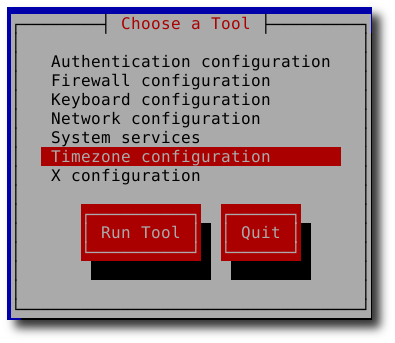
Fig.01: Redhat / CentOS Server Setting Up Timezone
Just follow on screen instructions to change the timezone.
If you are using Debian / Ubuntu Linux
To change the timezone for you run the following command as root user:
Again, just follow on screen instructions.
# dpkg-reconfigure tzdataAgain, just follow on screen instructions.
Set timezone using /etc/localtime configuration file [any Linux distro]
Often /etc/localtime is a symlink to the file localtime or to the correct time zone file in the system time zone directory.
Generic procedure to change timezone under Linux
Cd to /etc, run:
Create a symlink to file localtime:
OR some distro use /usr/share/zoneinfo/dirname/zonefile format (Red hat and friends):
OR if you want to set up it to IST (Asia/Calcutta):
Please note that in above example you need to use directory structure i.e. if you want to set the timezone to Calcutta (India) which is located in the Asia directory.
# cd /etcCreate a symlink to file localtime:
# ln -sf /usr/share/zoneinfo/EST localtimeOR some distro use /usr/share/zoneinfo/dirname/zonefile format (Red hat and friends):
# ln -sf /usr/share/zoneinfo/EST localtimeOR if you want to set up it to IST (Asia/Calcutta):
# ln -sf /usr/share/zoneinfo/Asia/Calcutta localtimePlease note that in above example you need to use directory structure i.e. if you want to set the timezone to Calcutta (India) which is located in the Asia directory.
How do I verify new settings?
Use the date command to verify that your timezone is changed:
Output:
$ dateOutput:
Tue Aug 27 14:46:08 EST 2006
How do I use of environment variable called TZ?
You can use TZ environment variable to display date and time according to your timezone:
Sample Output:
$ export TZ=America/Los_Angeles
$ date
Sample Output:
Thu Aug 27 11:10:08 PST 2006
Cluster configuration

Red Hat Cluster allows you to connect a group of computers (called nodes or members) to work together as a cluster. It provides a wide variety of ways to configure hardware and software to suit your clustering needs (for example, a cluster for sharing files on a GFS file system or a cluster with high-availability service failover). This book provides information about how to use configuration tools to configure your cluster and provides considerations to take into account before deploying a Red Hat Cluster. To ensure that your deployment of Red Hat Cluster fully meets your needs and can be supported, consult with an authorized Red Hat representative before you deploy it.
List of web browsers

List of web browsers
History:-
This is a table of personal computer web browsers by year of release of major version, in chronological order, with the approximate number of worldwide Internet users in millions. Note that Internet user data is related to the entire market, not the versions released in that year. The increased growth of the Internet in the 1990s and 2000s means that current browsers with small market shares have more total users than the entire market early on. For example, 90% market share in 1997 would be roughly 60 million users, but by the start of 2007 9% market share would equate to over 90 million users.
| Year | Web browsers | Internet users (in millions)[1][2][3] |
|---|---|---|
| 1991 | WorldWideWeb (Nexus) | 4 |
| 1992 | ViolaWWW, Erwise, MidasWWW, MacWWW (Samba) | 7 |
| 1993 | Mosaic, Cello,[4] Lynx 2.0, Arena, AMosaic 1.0 | 10 |
| 1994 | IBM WebExplorer, Netscape Navigator, SlipKnot 1.0, MacWeb, IBrowse, Agora (Argo), Minuet | 20 |
| 1995 | Internet Explorer 1, Netscape Navigator 2.0, OmniWeb, UdiWWW,[5] Internet Explorer 2, Grail | 16-39 |
| 1996 | Arachne 1.0, Internet Explorer 3.0, Netscape Navigator 3.0, Opera 2.0, PowerBrowser 1.5,[6] Cyberdog, Amaya 0.9,[7] AWeb, Voyager | 36-73 |
| 1997 | Internet Explorer 4.0, Netscape Navigator 4.0, Netscape Communicator 4.0, Opera 3.0,[8] Amaya 1.0[7] | 70-118 |
| 1998 | iCab, Mozilla | 147-184 |
| 1999 | Amaya 2.0,[7] Mozilla M3, Internet Explorer 5.0 | 248-278 |
| 2000 | Konqueror, Netscape 6, Opera 4,[9] Opera 5,[10] K-Meleon 0.2, Amaya 3.0,[7] Amaya 4.0[7] | 361-396 |
| 2001 | Internet Explorer 6, Galeon 1.0, Opera 6,[11] Amaya 5.0[7] | 513-499 |
| 2002 | Netscape 7, Mozilla 1.0, Phoenix 0.1, Links 2.0, Amaya 6.0,[7] Amaya 7.0[7] | 587-659 |
| 2003 | Opera 7,[12] Safari 1.0, Epiphany 1.0, Amaya 8.0[7] | 719-771 |
| 2004 | Firefox 1.0, Netscape Browser, OmniWeb 5.0 | 817-897 |
| 2005 | Safari 2.0, Netscape Browser 8.0, Opera 8,[13] Epiphany 1.8, Amaya 9.0,[7] AOL Explorer 1.0, Maxthon 1.0, Shiira 1.0 | 1018-1022 |
| 2006 | SeaMonkey 1.0, K-Meleon 1.0, Galeon 2.0, Camino 1.0, Firefox 2.0, Avant 11, iCab 3, Opera 9,[14] Internet Explorer 7 | 1093-1150 |
| 2007 | Maxthon 2.0, Netscape Navigator 9, NetSurf 1.0, Flock 1.0, Safari 3.0, Conkeror | 1319-1364 |
| 2008 | Konqueror 4, Safari 3.1, Opera 9.5,[15] Firefox 3, Amaya 10.0,[7] Flock 2, Chrome 1, Amaya 11.0[7] | 1574-1556 |
| 2009 | Internet Explorer 8, Chrome 2-3, Safari 4, Opera 10,[16] SeaMonkey 2, Camino 2, Firefox 3.5 | 1802-1743 |
| 2010 | K-Meleon 1.5.4, Firefox 3.6, Chrome 4-8, Opera 10.50,[17] Safari 5, xxxterm, Opera 11 | 1971-2012 |
| 2011 | Chrome 9-16, Firefox 4-9, Internet Explorer 9, Maxthon 3.0, SeaMonkey 2.1-2.3, Opera 11.50, Safari 5.1 | 2,267-2264 |
| 2012 | Chrome 17-23, Firefox 10-17, Internet Explorer 10, Opera 12, Safari 6 | 2,405 |
About Me

Cryptographic Algorithms
THE CRYPTOGRAPHY GUIDE
| |
Cryptographic Algorithms
DES This is the 'Data Encryption Standard'. This is a cipher that operates on 64-bit blocks of data, using a 56-bit key. It is a 'private key' system. Further Details on the DES Algorithm RSA RSA is a public-key system designed by Rivest, Shamir, and Adleman. Further Details on the RSA Algorithm HASH A 'hash algorithm' is used for computing a condensed representation of a fixed length message/file. This is sometimes known as a 'message digest', or a 'fingerprint'.. MD5 MD5 is a 128 bit message digest function. It was developed by Ron Rivest. Further Details on the MD5 Algorithm AES This is the Advanced Encryption Standard (using the Rijndael block cipher) approved by NIST. SHA-1 SHA-1 is a hashing algorithm similar in structure to MD5, but producing a digest of 160 bits (20 bytes).Because of the large digest size, it is less likely that two different messages will have the same SHA-1 message digest. For this reason SHA-1 is recommended in preference to MD5. HMAC HMAC is a hashing method that uses a key in conjunction with an algorithm such as MD5 or SHA-1. Thus one can refer to HMAC-MD5 and HMAC-SHA1 | |

Windows XP Network configuration
Windows XP Professional
Click Start -> Control Panel -> Network Connections.
Alternately, click Start ->, and right-click My Network Places then select Properties.
- On some installations the interface will be called Local Area Connection and on others it will be called Network Bridge. On our system it is called Network Bridge. Right-click on Network Bridge -> Properties.
- The Network Bridge Configuration, or Local Area Connection, panel is used to set TCP/IP protocol settings. In This connection uses the following items: box, click on Internet Protocol (TCP/IP), then click on Properties.The default setting is DHCP-enabled operation (i.e.“Obtain an IP address automatically”).Many network administrators will want to use DHCP to configure all client TCP/IP protocol stack settings.If it is necessary to provide a fixed IP address, click on “Use the following IP address” and enter the IP Address, the subnet mask, and the default gateway address in the boxes provided.
- Click the Advanced button to proceed with TCP/IP configuration. This opens a panel in which it is possible to create additional IP addresses for this interface. The technical name for the additional addresses is IP aliases, and additionally this panel permits the setting of more default gateways (routers). In most cases where DHCP is used, it will not be necessary to create additional settings.
Fixed settings may be required for DNS and WINS if these settings are not provided automatically via DHCP.
- Click the DNS tab to add DNS server settings. The example system uses manually configured DNS settings. When finished making changes, click the OK to commit the settings.DNS Configuration.
- Click the WINS tab to add manual WINS server entries. This step demonstrates an example system that uses manually configured WINS settings. When finished making changes, click OK to commit the settings.WINS Configuration
Network configuration in Linux
How to configure the network card in Red hat enterprise Linux 5 and Centos 5
You can configure network card by editing text files stored in
/etc/sysconfig/network-scripts/ directory.
First change directory to /etc/sysconfig/network-scripts/:
# cd /etc/sysconfig/network-scripts/
You need to edit files as follows:
/etc/sysconfig/network-scripts/ifcfg-eth0 : First Ethernet card configuration file
/etc/sysconfig/network-scripts/ifcfg-eth1 : Second Ethernet card configuration file
To edit/create first NIC file, type command:
# vi ifcfg-eth0
modify as follows:
# Intel Corporation 82573E Gigabit Ethernet Controller (Copper)
DEVICE=eth0
BOOTPROTO=static
DHCPCLASS=
HWADDR=00:30:48:56:A6:2E
IPADDR=192.168.1.2
NETMASK=255.255.255.0
ONBOOT=yes
Save and close the file. Define default gateway (router IP) and hostname in
/etc/sysconfig/network file:
# vi /etc/sysconfig/network
Append/modify configuration as follows:
NETWORKING=yes
HOSTNAME=server1.example.com
GATEWAY=192.168.1.1
Save and close the file. Restart networking:
# /etc/init.d/network restart
Make sure you have correct DNS server defined in /etc/resolv.conf file:
# vi /etc/resolv.conf
Setup DNS Server as follows:
nameserver XX.XX.XX.XX
nameserver XX.XX.XX.XX
OOPs Concepts
| OOPs – Object Oriented Programming System Object-oriented programming (OOP) is a programming paradigm that uses “Objects “and their interactions to design applications and computer programs. There are different types of OOPs are used, they are
1) Object :Object is the basic unit of object-oriented programming. Objects are identified by its unique name. An object represents a particular instance of a class. There can be more than one instance of an object. Each instance of an object can hold its own relevant data.
An Object is a collection of data members and associated member functions also known as methods.
For example whenever a class name is created according to the class an object should be created without creating object can’t able to use class.
The class of Dog defines all possible dogs by listing the characteristics and behaviors they can have; the object Lassie is one particular dog, with particular versions of the characteristics. A Dog has fur; Lassie has brown-and-white fur.
2) Class :
Classes are data types based on which objects are created. Objects with similar properties and methods are grouped together to form a Class. Thus a Class represents a set of individual objects. Characteristics of an object are represented in a class as Properties. The actions that can be performed by objects become functions of the class and is referred to as Methods.
For example consider we have a Class of Cars under which Santro Xing, Alto and WaganR represents individual Objects. In this context each Car Object will have its own, Model, Year of Manufacture, Colour, Top Speed, Engine Power etc., which form Properties of the Car class and the associated actions i.e., object functions like Start, Move, Stop form the Methods of Car Class.No memory is allocated when a class is created. Memory is allocated only when an object is created, i.e., when an instance of a class is created.
|
3) Data abstraction & Encapsulation :The wrapping up of data and its functions into a single unit is called Encapsulation.
When using Data Encapsulation, data is not accessed directly, it is only accessible through the functions present inside the class.
Data Abstraction increases the power of programming language by creating user defined data types. Data Abstraction also represents the needed information in the program without presenting the details.
Abstraction refers to the act of representing essential features without including the background details or explanation between them.
For example, a class Car would be made up of an Engine, Gearbox, Steering objects, and many more components. To build the Car class, one does not need to know how the different components work internally, but only how to interface with them, i.e., send messages to them, receive messages from them, and perhaps make the different objects composing the class interact with each other.
4) Inheritance :
Inheritance is the process of forming a new class from an existing class or base class.
Inheritance is the process of forming a new class from an existing class or base class.
The base class is also known as parent class or super class, the new class that is formed is called derived class.
Derived class is also known as a child class or sub class. Inheritance helps in reducing the overall code size of the program, which is an important concept in object-oriented programming.
It is classifieds into different types, they are
- Single level inheritance
- Multi-level inheritance
- Hybrid inheritance
- Hierarchial inheritance
5) Polymorphism :
Polymorphism allows routines to use variables of different types at different times. An operator or function can be given different meanings or functions. Polymorphism refers to a single function or multi-functioning operator performing in different ways.
Polymorphism allows routines to use variables of different types at different times. An operator or function can be given different meanings or functions. Polymorphism refers to a single function or multi-functioning operator performing in different ways.
Poly a Greek term ability to take more than one form. Overloading is one type of Polymorphism. It allows an object to have different meanings, depending on its context. When an exiting operator or function begins to operate on new data type, or class, it is understood to be overloaded.
6) Dynamic binding :
It contains a concept of Inheritance and Polymorphism.
It contains a concept of Inheritance and Polymorphism.
7) Message Passing :It refers to that establishing communication between one place to another.
Setup The Timezone
HowTo: Linux Server Change OR Setup The Timezone
Unix time, or POSIX time, is a system for describing points in time: it is the number of seconds elapsed since midnight UTC on the morning of January 1, 1970, not counting leap seconds. The definition for time zones can be written in short form as UTC±n (or GMT±n), where n is the offset in hours. You can use the following commands:
[a] setup or redhat-config-date for RHEL based distros.
[b] dpkg-reconfigure tzdata for Debian based distros.
[c] ln command - Generic method for all other distros.
Command to change the Linux timezone
You need to type the following commands as per your Linux distribution.
If you are using Fedora / RHEL / Cent OS Linux
Type the redhat-config-date command at the command line to start the time and date properties tool, run:
OR type setup and select time zone configuration. This tool is recommended for remote ssh text based sessions.
Select timezone configuration
# redhat-config-dateOR type setup and select time zone configuration. This tool is recommended for remote ssh text based sessions.
# setupSelect timezone configuration
Fig.01: Redhat / CentOS Server Setting Up Timezone
Just follow on screen instructions to change the timezone.
If you are using Debian / Ubuntu Linux
To change the timezone for you run the following command as root user:
Again, just follow on screen instructions.
# dpkg-reconfigure tzdataAgain, just follow on screen instructions.
Set timezone using /etc/localtime configuration file [any Linux distro]
Often /etc/localtime is a symlink to the file localtime or to the correct time zone file in the system time zone directory.
Generic procedure to change timezone under Linux
Cd to /etc, run:
Create a symlink to file localtime:
OR some distro use /usr/share/zoneinfo/dirname/zonefile format (Red hat and friends):
OR if you want to set up it to IST (Asia/Calcutta):
Please note that in above example you need to use directory structure i.e. if you want to set the timezone to Calcutta (India) which is located in the Asia directory.
# cd /etcCreate a symlink to file localtime:
# ln -sf /usr/share/zoneinfo/EST localtimeOR some distro use /usr/share/zoneinfo/dirname/zonefile format (Red hat and friends):
# ln -sf /usr/share/zoneinfo/EST localtimeOR if you want to set up it to IST (Asia/Calcutta):
# ln -sf /usr/share/zoneinfo/Asia/Calcutta localtimePlease note that in above example you need to use directory structure i.e. if you want to set the timezone to Calcutta (India) which is located in the Asia directory.
How do I verify new settings?
Use the date command to verify that your timezone is changed:
Output:
$ dateOutput:
Tue Aug 27 14:46:08 EST 2006
How do I use of environment variable called TZ?
You can use TZ environment variable to display date and time according to your timezone:
Sample Output:
$ export TZ=America/Los_Angeles
$ date
Sample Output:
Thu Aug 27 11:10:08 PST 2006
Cluster configuration
Red Hat Cluster allows you to connect a group of computers (called nodes or members) to work together as a cluster. It provides a wide variety of ways to configure hardware and software to suit your clustering needs (for example, a cluster for sharing files on a GFS file system or a cluster with high-availability service failover). This book provides information about how to use configuration tools to configure your cluster and provides considerations to take into account before deploying a Red Hat Cluster. To ensure that your deployment of Red Hat Cluster fully meets your needs and can be supported, consult with an authorized Red Hat representative before you deploy it.
List of web browsers
List of web browsers
History:-
This is a table of personal computer web browsers by year of release of major version, in chronological order, with the approximate number of worldwide Internet users in millions. Note that Internet user data is related to the entire market, not the versions released in that year. The increased growth of the Internet in the 1990s and 2000s means that current browsers with small market shares have more total users than the entire market early on. For example, 90% market share in 1997 would be roughly 60 million users, but by the start of 2007 9% market share would equate to over 90 million users.
| Year | Web browsers | Internet users (in millions)[1][2][3] |
|---|---|---|
| 1991 | WorldWideWeb (Nexus) | 4 |
| 1992 | ViolaWWW, Erwise, MidasWWW, MacWWW (Samba) | 7 |
| 1993 | Mosaic, Cello,[4] Lynx 2.0, Arena, AMosaic 1.0 | 10 |
| 1994 | IBM WebExplorer, Netscape Navigator, SlipKnot 1.0, MacWeb, IBrowse, Agora (Argo), Minuet | 20 |
| 1995 | Internet Explorer 1, Netscape Navigator 2.0, OmniWeb, UdiWWW,[5] Internet Explorer 2, Grail | 16-39 |
| 1996 | Arachne 1.0, Internet Explorer 3.0, Netscape Navigator 3.0, Opera 2.0, PowerBrowser 1.5,[6] Cyberdog, Amaya 0.9,[7] AWeb, Voyager | 36-73 |
| 1997 | Internet Explorer 4.0, Netscape Navigator 4.0, Netscape Communicator 4.0, Opera 3.0,[8] Amaya 1.0[7] | 70-118 |
| 1998 | iCab, Mozilla | 147-184 |
| 1999 | Amaya 2.0,[7] Mozilla M3, Internet Explorer 5.0 | 248-278 |
| 2000 | Konqueror, Netscape 6, Opera 4,[9] Opera 5,[10] K-Meleon 0.2, Amaya 3.0,[7] Amaya 4.0[7] | 361-396 |
| 2001 | Internet Explorer 6, Galeon 1.0, Opera 6,[11] Amaya 5.0[7] | 513-499 |
| 2002 | Netscape 7, Mozilla 1.0, Phoenix 0.1, Links 2.0, Amaya 6.0,[7] Amaya 7.0[7] | 587-659 |
| 2003 | Opera 7,[12] Safari 1.0, Epiphany 1.0, Amaya 8.0[7] | 719-771 |
| 2004 | Firefox 1.0, Netscape Browser, OmniWeb 5.0 | 817-897 |
| 2005 | Safari 2.0, Netscape Browser 8.0, Opera 8,[13] Epiphany 1.8, Amaya 9.0,[7] AOL Explorer 1.0, Maxthon 1.0, Shiira 1.0 | 1018-1022 |
| 2006 | SeaMonkey 1.0, K-Meleon 1.0, Galeon 2.0, Camino 1.0, Firefox 2.0, Avant 11, iCab 3, Opera 9,[14] Internet Explorer 7 | 1093-1150 |
| 2007 | Maxthon 2.0, Netscape Navigator 9, NetSurf 1.0, Flock 1.0, Safari 3.0, Conkeror | 1319-1364 |
| 2008 | Konqueror 4, Safari 3.1, Opera 9.5,[15] Firefox 3, Amaya 10.0,[7] Flock 2, Chrome 1, Amaya 11.0[7] | 1574-1556 |
| 2009 | Internet Explorer 8, Chrome 2-3, Safari 4, Opera 10,[16] SeaMonkey 2, Camino 2, Firefox 3.5 | 1802-1743 |
| 2010 | K-Meleon 1.5.4, Firefox 3.6, Chrome 4-8, Opera 10.50,[17] Safari 5, xxxterm, Opera 11 | 1971-2012 |
| 2011 | Chrome 9-16, Firefox 4-9, Internet Explorer 9, Maxthon 3.0, SeaMonkey 2.1-2.3, Opera 11.50, Safari 5.1 | 2,267-2264 |
| 2012 | Chrome 17-23, Firefox 10-17, Internet Explorer 10, Opera 12, Safari 6 | 2,405 |
Subscribe to:
Posts (Atom)
-
 Less Infrastructure, More Intelligent Servers Cisco Unified Computing System (UCS) and servers unify computing, networking, mana...
 -
 RSA Algorithm Example Choose p = 3 and q = 11 Compute n = p * q = 3 * 11 = 33 Compute φ(n) = (p - 1) * (q - 1) = 2 * 10 = 20 Ch...
 -
 List of web browsers History:- This is a table of personal computer web browsers by year of release of major version, in ch...
 -
 CISCO ROUTER SERIES The industry’s most widely deployed universal services aggregation router for enterprise and service provider ...
 -
 Basic Concept of VLAN VLAN(Virtual Local Area Network)What is this VLAN ? Why we are using VLAN? How to configure VLAN? all is explain...
 -
 Using Wine In Red Hat Linux Wine is a great tool for Linux users who want to install and run Windows ...
 -
.jpg) Step 1. Select folders for protect Copy Folder Protector (lockdir.exe) to the folder you want to protect or drag and drop th...
Step 1. Select folders for protect Copy Folder Protector (lockdir.exe) to the folder you want to protect or drag and drop th... -
 CREAT BACKDOOR :::::::::::::::::::::::::::::::::::::::::::::::::::::::::...
 -
 A Comparison of Network Models There are two network models that describe how networks 'work'. The OSI Model , the older model,...
 -
.jpg) THE CRYPTOGRAPHY GUIDE Cryptographic Algorithms There are of course a wide range of cryptographic algorithms in use. The f...
THE CRYPTOGRAPHY GUIDE Cryptographic Algorithms There are of course a wide range of cryptographic algorithms in use. The f...